How to Watch UK TV in Your Alpine Chalet — Winter, Summer and Every Let in Between
You'll know this better than we do, but a chalet does have a way of generating friends. Somebody always wants a week.
All of which is rather lovely, and it's also why the television turns into a problem — because the person standing in front of it is very often not you. None of them is going to set up a VPN app on somebody else's telly, and you're three countries away and in no position to do it for them.
That's the real difficulty with British television in a chalet, and it's why the answer belongs in the building rather than in an app.
It Is Rarely Just You in Front of the Television
Over a year, the list tends to look something like this.
- You and the family, for the weeks you've blocked out.
- Friends who've borrowed it — and who will text you at nine o'clock at night because the telly is doing something odd.
- Paying guests, if you let it. They booked a place with a television in the description and they expect it to behave like one.
Every one of them wants the same thing: to sit down, pick up a remote, and watch BBC iPlayer. Not one of them wants a conversation about IP addresses — and frankly nor do you, on holiday, on the telephone, from a chairlift.
The Alps Have Two Seasons Now
There's also the small matter of July.
Summer in the Alps is a proper season now — walking, biking, the lakes, and rather better weather than the coast. Plenty of chalets let for as many summer weeks as winter ones.
A router that only earns its keep in February is a poor piece of kit. One that simply works whenever anyone is in the building is a different proposition entirely.
Why the Television Stops at the Border
Nothing is wrong with your subscriptions. You still pay for them, they're still live, and they still work perfectly in Surrey.
What changed is the address your connection arrives from. BBC iPlayer, ITVX, Sky and the rest are licensed for the UK, and they look at where your connection is coming from before they play anything. From a French valley, they simply decline.
The usual answer is a VPN app, and it fails twice over. The big-name apps route you through data-centre IP addresses that the broadcasters have known for years — our guide on why ExpressVPN, NordVPN and Surfshark stop working covers why. And even when one does work, it works on one device, for whoever set it up. That's no use at all in a house full of other people.
The Internet Is Probably Fine. The Wi-Fi Might Not Be.
There's a myth that Alpine broadband is hopeless. In the major resorts it simply is not: fibre has reached Courchevel, Méribel, Val d'Isère and Verbier, and it's being pushed further up the valleys every year.
Two real caveats, though, and they're worth knowing before you order anything.
The first is that being able to connect is not the same as being connected — a chalet can sit on a fibred street and still be waiting for the final run to the door. Check what you actually have, not what the resort claims.
The second is the one that catches everybody: the problem is usually not the line, it's the Wi-Fi. Three or four floors of stone, timber and old walls will defeat a single router, and what feels like "bad internet" in the top bedroom is very often a signal that never got there.
Which SmartHub for a Chalet
This is a genuine fork, and one question decides most of it: does the chalet already have a mesh or extra access points?
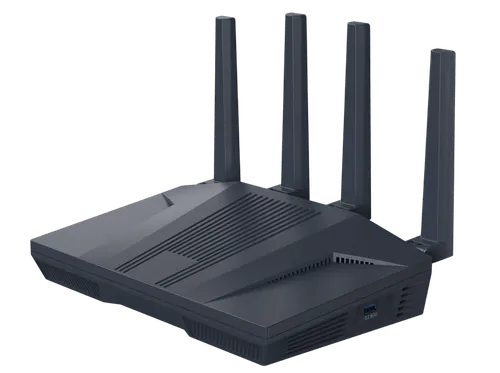
If it does — and in a big property it very often does — the SmartHub Core is the one. It's an Ethernet-only gateway with no Wi-Fi of its own, and it sits inline between the local internet box and the mesh you already have. Everything in the building then arrives from a UK residential IP address, on the existing Wi-Fi, with nothing for a guest to choose and nothing for you to explain.
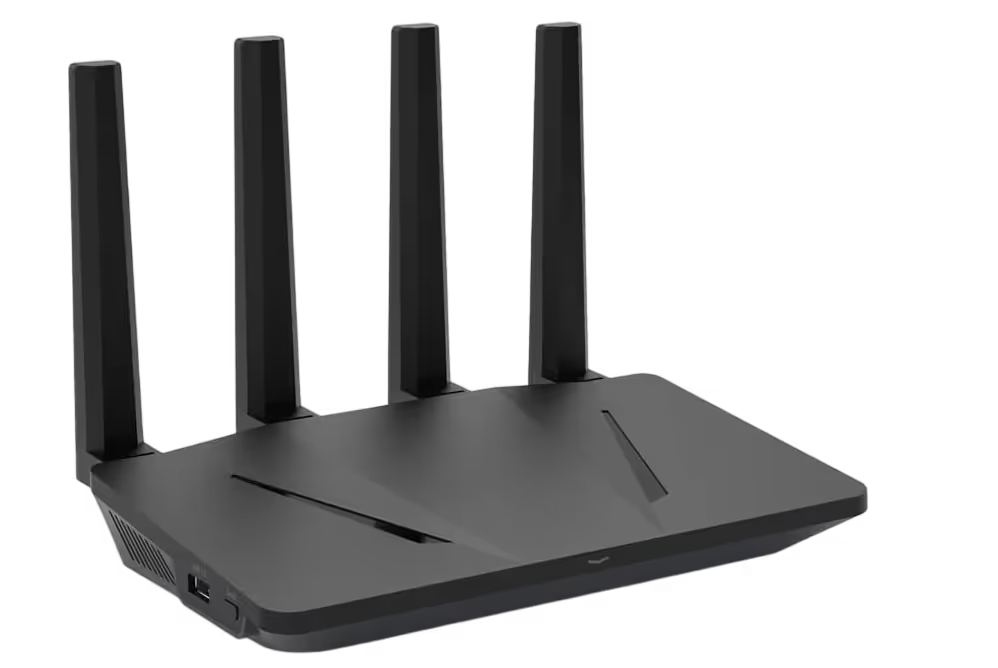
If it doesn't, the SmartHub Pro is the answer. It brings its own Wi-Fi and the headroom for a house full of devices, standing up a British network alongside the local one.
One thing not to do: don't buy the Core for a chalet with no mesh — there'd be no Wi-Fi for anyone to join.
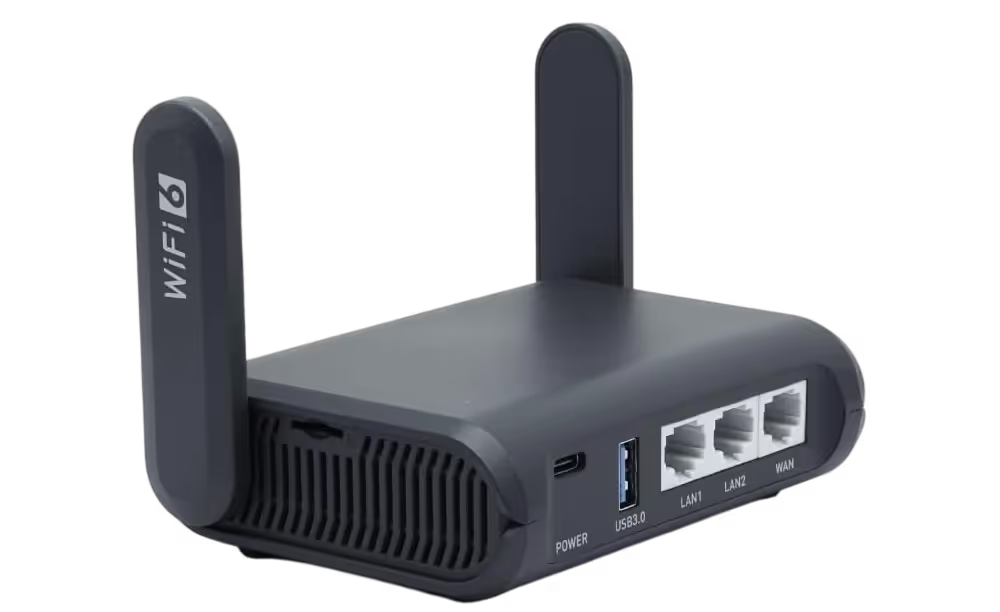
And there's a third answer worth knowing about. If the chalet is one of several places you go — a week in the Alps, a fortnight in Spain, a few nights in a hotel — the SmartHub Travel is the one that goes in the case with you. It won't blanket a four-storey building on its own, but it will cover the room you're sitting in, wherever that room happens to be, and it means one router rather than one per property.
Plenty of chalet owners buy it for exactly that reason. The router comparison weighs all four up properly.
What About a Dish?
People do fit satellite in the Alps, and we're not going to pretend it never works.
But it's a poor thing to build on now. Sky's satellite capacity is contracted only to 2029, no replacement has been ordered for the UK slot, and Sky Q has already been pulled from online sale. A dish in a steep valley is also a lottery — you need a clear view in one particular direction, and the mountain may simply be in the way.
The internet is going to be there long after the satellite is not, and it doesn't care which way the chalet faces.
Fit It Once
The whole point of doing this properly is that you only do it once.
The router arrives pre-configured. Somebody plugs it in — you, the caretaker, the friend who's up there anyway — and from then on the television in that chalet is a British television. It stays that way through the ski weeks, through the summer, and through every let in between — without anyone having to touch it again.
Nobody has to remember a password. It works for whoever happens to be standing in the kitchen.
If you have a Control4 or similar system in, there's one extra question worth asking your installer — we've written that up in our guide to Control4 and Araknis routers.
Give Them a Remote and a Channel List
The router fixes the address. There's a second piece worth having, and in a chalet full of other people it may matter more.
A Freely TV box puts live British television and catch-up onto the screen over the internet — no dish, no aerial, and nothing to sign into. Your guest picks up a remote, presses one, and BBC One is where BBC One ought to be.
That's the whole difficulty of a chalet solved in a sentence. Nobody has to be shown an app. Nobody has to be told which tile to press. It simply behaves like a television, which is all any of them wanted.
Both boxes we supply do the free-to-view channels perfectly well. The Netgem PLEIO also runs the NOW app, and it's the only one of the two that does — worth having if the chalet wants Sky Sports for the rugby or the football.
The Manhattan Aero takes a wired Ethernet connection and has the simpler interface, which is the better answer if the television sits near the network cabinet and you'd rather guests had fewer choices, not more.
Frequently Asked Questions
How can guests watch UK TV in my Alpine chalet without any setup?
Put the fix in the building, not on the telly. A pre-configured VPN router on a UK residential IP means anyone — family, friends who have borrowed the place, or paying guests — just picks up the remote and watches BBC iPlayer. Nobody sets up a VPN app on someone else's television, and you don't get the nine-o'clock text.
Which SmartHub router suits a chalet?
It depends on one thing: does the chalet already have a mesh or extra access points? If it does, the SmartHub Core sits inline behind it so the whole building arrives from a UK IP on the existing Wi-Fi. If it does not, the SmartHub Pro brings its own Wi-Fi and the headroom for a house full of devices. If the chalet is one of several places you go, the Travel packs in the case instead.
Is Alpine broadband good enough to stream UK TV?
Usually, yes — fibre has reached the major resorts like Courchevel, Méribel and Val d'Isère. Two things to check: that the final run actually reaches your door, not just the street, and that the Wi-Fi carries through the building — several floors of stone and timber often defeat a single router, which is what feels like poor internet in the top bedroom.
Is it worth fitting a satellite dish instead?
Not any more. A dish in a steep valley needs a clear line of sight the mountain may block, and UK satellite TV is winding down. Broadband reaches the chalet whichever way it faces and it'll outlast the dish — a VPN router with a UK residential IP is the more future-proof fix.
Final Thoughts
Treat the television the way you treat the boiler: something that belongs to the building, is dealt with once, and then is not thought about again.
A pre-configured VPN router with a genuine UK residential IP makes your own subscriptions behave in the Alps the way they behave at home — for every device in the chalet, all year, whoever is in it. It's not a Christmas purchase. It's part of the house.
At Stream UK TV Abroad we ship the routers ready to plug in, worldwide. For international orders we generally use UPS Express, keeping delivery and customs clearance as fast and hassle-free as possible; UK orders ship with DPD, usually next-day after dispatch — handy if you'd rather take it out with you.